May 30 - June 28 | 2026
Opening Reception during Fish-A-Palooza II | May 30
Video created by Garold Sneegas
By Bridget Bryan, from a conversation with Garold Sneegas in April 2026
Kansas is known for having a high percentage of polluted streams. That can make it difficult to see and know the fish that thrive in our waterways. But Volland is nestled in the Flint Hills of Kansas, where the water runs off hills of native grass and forms streams as clear as gin.
Garold says, “In a few isolated areas of the state, there are still a few clear, pristine streams.” Those areas are mostly on private land, and Garold was able to access a few of these places by obtaining permission from the landowners. Respecting the property helps maintain the quality of the streams: “The requests and conditions set by a landowner are not only something to be followed but are also a form of protection for the streams themselves.”
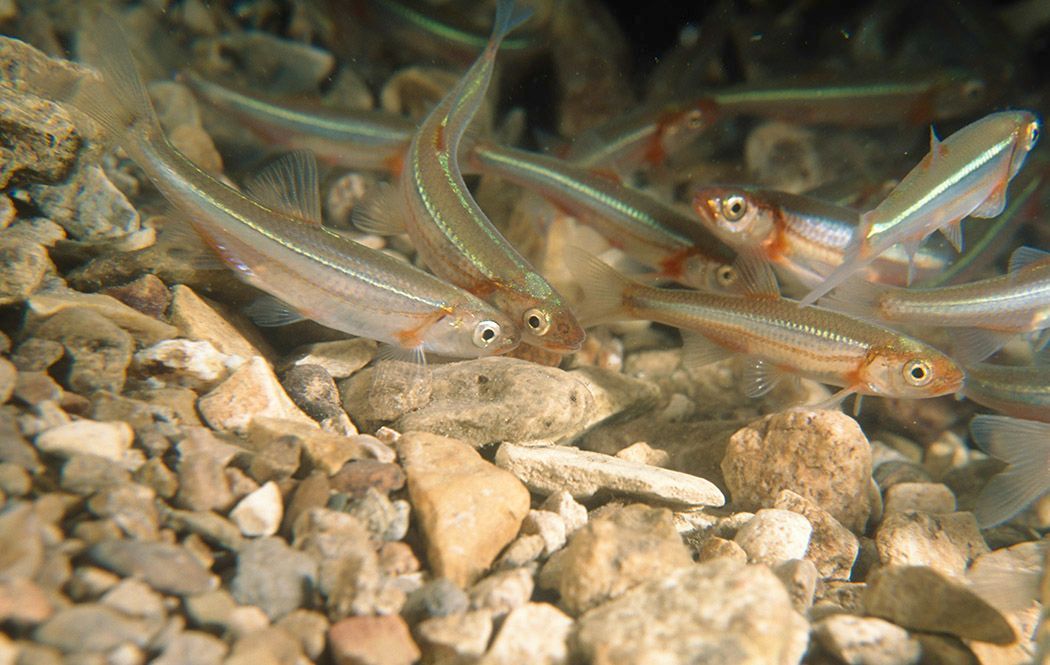
Why does he want to go into the water to look for these fish? Garold wants to photograph the fish underwater in their natural habitat, interacting with each other. “You can capture their peak spawning colors and natural behaviors in a way that cannot be duplicated in an aquarium,” he shares. Only in natural aquatic environments —which have so many varying conditions— can you capture life as it organically happens. “There are random interactions between migrating fish species and other aquatic inhabitants,” Gary shares. “Capturing an image of spawning male darters, displaying at their peak moment of excitement in the wild, requires being in the right place at the right time. You may be lucky and stumble onto this situation in a matter of minutes, or you may have to spend hours submerged in 50-degree water monitoring an area.”
Those hours, whether during the day or at night (some fish are so skittish that it’s only at night that he can capture images of them), Garold seeks to understand the fishes he photographs — and he’s found it necessary to explore their habitats during all seasons. “In doing so,” Garold posits, "one also becomes aware of the other inhabitants that coexist with the fishes. I have not only enjoyed photographing the common aquatic organisms the general public is familiar with such as crayfish, turtles, and insect larvae, but also some unusual invertebrates like freshwater sponges, bryozoans and hydras.”
Garold started diving in 1969 in Lawrence. He began snorkeling as a 12- to 13-year-old. Once, he followed a fishing lure led by the line, as he often did, and found a sunken rowboat —and a big catfish emerged from the boat. He saw a lot of fascinating things and would describe them, but no one believed him, so he started to figure out ways to photograph them.
Garold attended college in Pittsburgh, KS, where he earned a Bachelor of Science in Biology. Pittsburgh is considered part of the Ozark Highlands region. There, he continued diving, exploring Ozark streams and nearby strip mines. His studies of fish and limnology with Dr. Carl Bass enhanced his exploration. Limnology is the study of inland bodies of waters and their ecosystems.
Garold found freshwater sponges and jellyfish —ask him where you can find them!
After college, Garold became a diving instructor at Beaver Lake and Table Rock Lake, clear, lovely locations for diving.
Garold had an opportunity to travel to South America and explore the Amazon and a large tributary, the Rio Negro. There he saw freshwater varieties of sting rays, puffer fish, and even dolphins.
Photography was not Garold’s main source of income; in fact, he fell away from it from 1978-1986. He worked in construction, eventually owned his own company, and did some diving trips here and there, including saltwater diving in the Caribbean and the Great Barrier Reef.
In 1992 things began to shift. Garold heard that Freshwater Fishes of KS was being revised. He submitted some of his photographs, which were subsequently selected for the revision. After that, he began to get a lot of calls for photography, mostly for scientific books.
A Fishes of TX Project (at the University of Texas at Austin) helped cement his career as a full-time underwater fish photographer. Garold was assigned to go to different areas of the state. At Devil’s River, he experienced mesquite, cactus, thorns, and the Edwards Aquifer oasis. He was told he would likely not find the Devil’s River minnow, a threatened species, but he discovered never-before-seen thriving pockets of the elusive and threatened minnow.
His favorite experiences are two: Discovering the surprising population of the Devil’s River minnow and exploring Flint Hills streams. The more he learned about the prairie streams, the more fascinated he became.
When asked what his favorite fish is, Garold replied “The last really good picture!” He also favors the spawning sunfish.
These days, it is not as easy to access the hidden, private, off-the-beaten path Flint Hills streams as it was in his earlier years, and Garold has developed a new hobby - photography of birds. “You don’t even have to get out of the car for a good picture,” he laughed.
ABOUT GARY STAAB
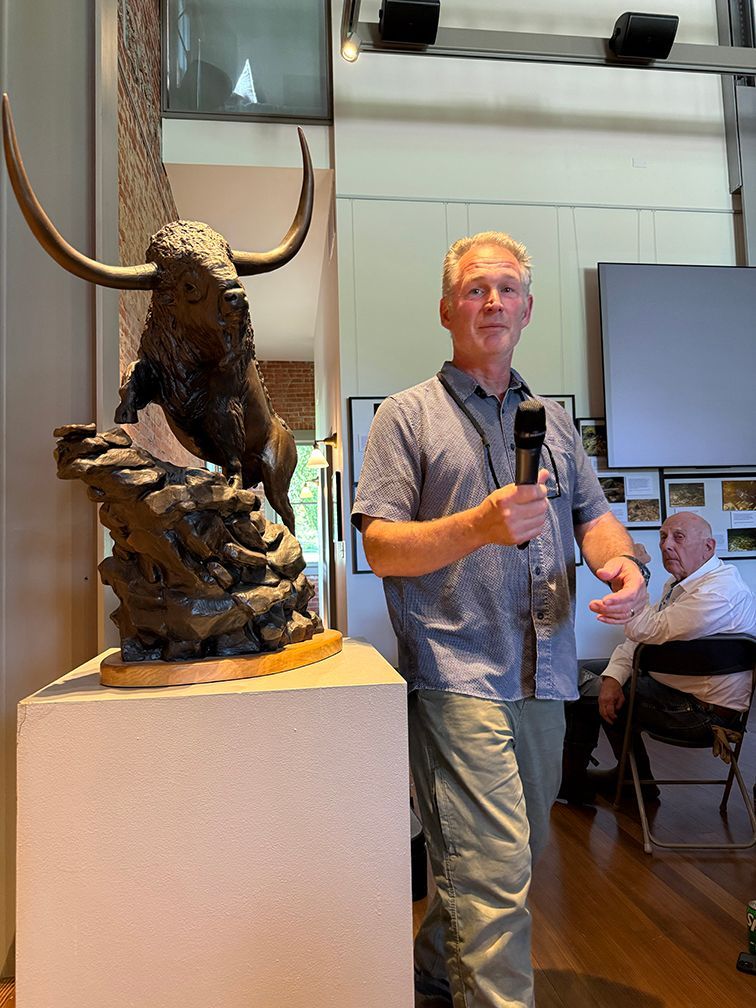
Gary Staab calls himself a Paleoartist, a Naturalist, and a Maker. His work recreates ancient fossils, skeletal remains, and living creatures at scale and mammoth size.
As a little boy in Grand Island, Nebraska, he enjoyed looking for bugs underneath rocks.
On a field trip at a museum, he wondered what it would be like to be the person who made the birds and animals he was seeing. That wondering, paired with his enjoyment of drawing and making things with his hands, paved the way for what he does today.
His most current project, two giant bronze bison and a calf, in honor of America's 250th Anniversary, flank the entrance of the Smithsonian Museum of Natural History. The installation was recently celebrated on national TV.
Gary Staab's clients reflect the institutions where he interned. One of his first internships was at the Smithsonian Institution in Washington, D.C., and the British Museum of Natural History in London, during which he pursued a customized degree in art and biology at Hastings College.
Gary sculpted for seven years at the Denver Museum of Nature and Science and then became a freelance artist in 1996. Since then, Gary has never experienced a lack of commissions.